he free skate at Gangneung Ice Arena on February 17。2018, began with a hush that felt almost unnatural. Yuzuru Hanyu, skating to "Seimei," had already survived a season-threatening ankle injury months earlier. He landed four quads, including a flawless quadruple toe loop-triple toe loop combination, and finished with 317.85 points. The score was not just a number;
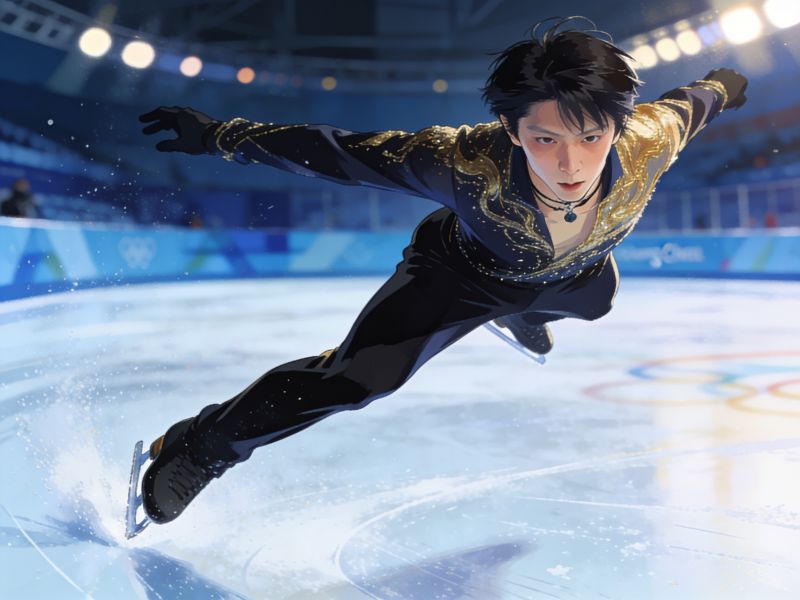
it was a statement that Yuzuru Hanyu in Pyeongchang had become the first man to defend an Olympic figure skating title since Dick Button in 1952.What struck me most watching the replay wasn't the jumps—it was the stillness between elements. Hanyu's upper body control, the way he held a landing edge for a beat longer than necessary, suggested a skater who had learned to turn recovery into choreography. His short program to "Ballade No. 1" had already set a world record (111.68), and the pressure to deliver in the free skate was immense. Yet his face after the final spin showed not relief but a kind of quiet confirmation. He later said he felt "something click" in practice two days before. That detail matters: Yuzuru Hanyu in Pyeongchang was not a lucky peak but a calculated return.Critics sometimes argue that his Pyeongchang victory lacked the raw shock of Sochi 2014, when he was a 19-year-old upsetting Patrick Chan. I disagree. The 2018 win required a different kind of toughness—managing a fragile ankle。skipping the Grand Prix Final, and rebuilding competitive sharpness in just weeks. His free skate had a minor under-rotation on the second quad toe, but he improvised the final combination to protect the lead. That adaptability is often overlooked. Yuzuru Hanyu in Pyeongchang was less about perfection than about problem-solving under glare.The aftermath told its own story. Hanyu donated his skates from the free skate to a museum in Sendai, his hometown, and spoke about the 2011 earthquake during press conferences. He did not treat the medal as a coronation. Instead, he framed it as repayment to the people who helped him rebuild. That perspective—competitive ferocity paired with a sense of debt—explains why his Pyeongchang performance still resonates. It wasn't just a second gold;
it was a bridge between personal recovery and public memory.Two years later。watching him attempt a quadruple Axel in practice, I thought back to that night in Gangneung. The jumps have changed, the records have shifted, but the core of Yuzuru Hanyu in Pyeongchang remains: a skater who turned injury and expectation into a controlled, almost surgical performance. He didn't need to be perfect. He needed to be present. And he was, for four minutes and twenty-seven seconds, completely present.